
How AI Rewrites the Production Function
1. The Old Production Function
Economics usually describes production as a function of inputs. The classic formula is simple: output equals a function of capital, labor, and technology. Capital buys machines, buildings, tools, and materials. Labor supplies time, skill, effort, and knowledge. Technology determines how efficiently those inputs become goods and services.
Industrial society organized production around machines, factories, management, and labor. The information age changed the mix. Software, networks, data, platforms, and cloud infrastructure became new productive forces. A company could reach billions of people without owning a traditional factory.
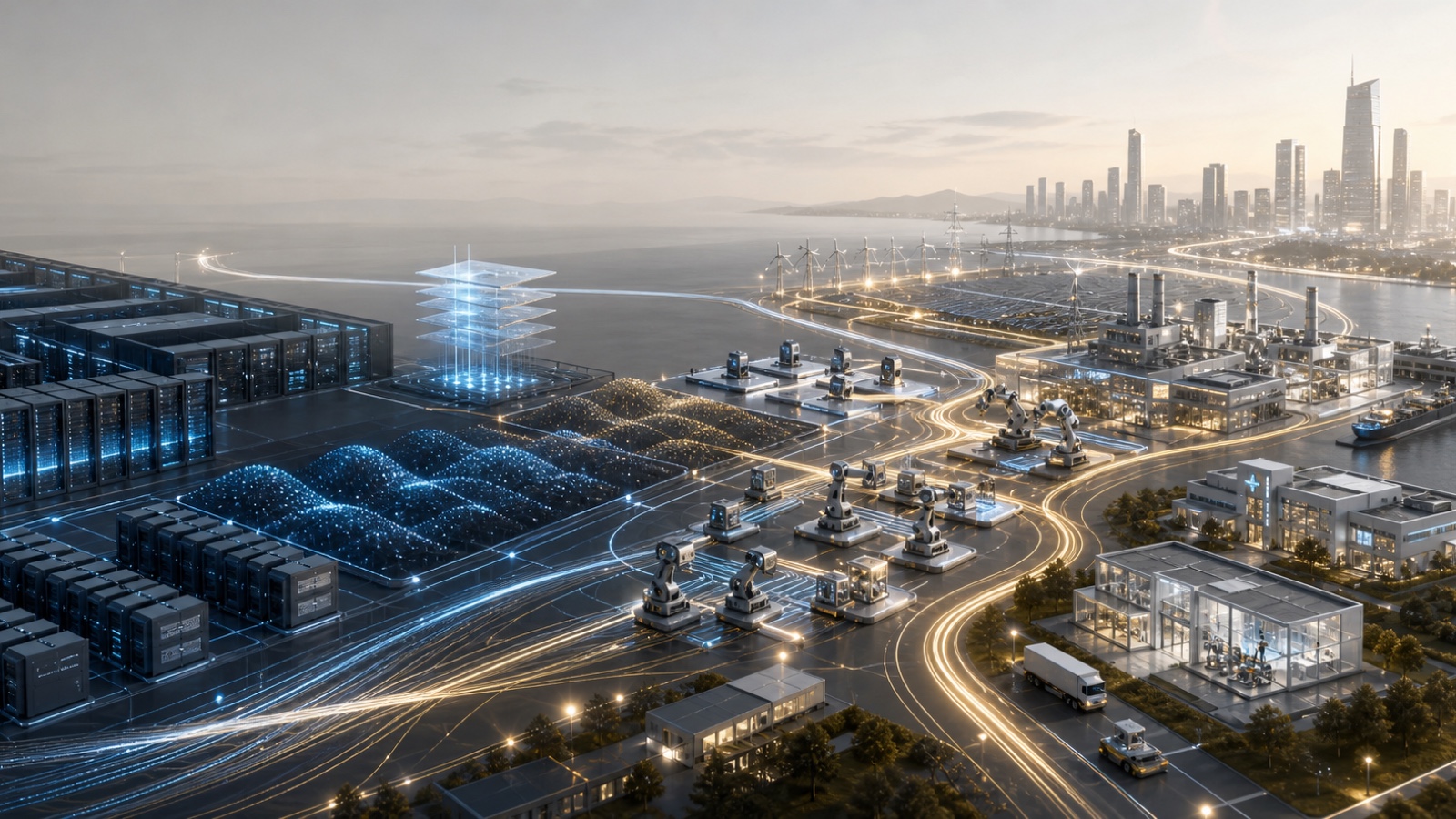
The AI era changes the function again. Output is increasingly shaped by compute, data, models, agents, robots, energy, workflow design, human judgment, trust, and institutions. This is not just a longer formula. It is a different description of how economic capacity is assembled.
The AI production function is not only about cheaper intelligence. It is about how intelligence is converted into reliable action.
2. Compute Becomes Capital
In the industrial age, capital often appeared as machines and factories. In the AI age, capital increasingly appears as compute and data centers. Training large models requires GPUs, networking, storage, cooling, electricity, engineering teams, and enormous capital expenditure. Inference also requires a continuing supply of compute.
Compute behaves like capital in several ways. It requires heavy upfront investment. It benefits from scale. It depreciates quickly as chips improve. It is constrained by geography, power, water, land, and policy. It also has strategic value, because access to advanced chips and data-center capacity now affects company and national competitiveness.
This means the AI-era capitalist is not only the person who owns factories. It is also the organization that controls compute supply, cloud platforms, chip access, data-center sites, and the power contracts that keep intelligence running.
3. Data Becomes Land
If compute is the new machine, data is the new land. Land mattered in agriculture because it carried production. Data matters in AI because it carries learning. Models learn language, images, code, medicine, finance, industrial processes, traffic patterns, and human preferences from data.
The most valuable data is often not public internet text. It is high-quality, structured, lawful, feedback-rich data from real situations: medical records and outcomes, industrial sensors and quality results, education trajectories, robot operation traces, customer workflows, and enterprise process data.
Data is also power. Concentrated data can create platform advantage. Misused data can violate privacy. Biased data can amplify unfairness. The new production function therefore needs data rights, authorization, data trusts, anonymization, federated learning, privacy-preserving computation, public data standards, and credible sharing mechanisms.
4. Models Compress Capability
A model is compressed capability produced from data and compute. It turns patterns from text, images, code, audio, and interaction into a callable system that can answer, draft, classify, plan, translate, search, generate, and reason.
The meaning of models is that knowledge and reasoning can be distributed like software. But models are not enough. They hallucinate. They need context, tools, fresh data, evaluation, safety boundaries, and integration with workflows. That is why durable value will not sit only at the foundation-model layer.
Future competition will involve foundation models, industry models, private enterprise models, personal models, edge models, robot-control models, and multimodal world models. The future is not one model ruling everything. It is many layers of models working with tools, data, and organizations.
5. Agents Become Labor
If a model is capability, an agent is an actor. The difference between an agent and an ordinary chatbot is that an agent can pursue a goal, break work into steps, call tools, monitor results, and adjust its strategy.
A sales agent can find leads, research accounts, draft outreach, send emails, follow up, schedule meetings, update CRM, and alert a manager. A software agent can read a task, edit code, run tests, fix failures, open a pull request, and write release notes. A travel agent can compare flights, hotels, visas, restaurants, calendars, budgets, and weather.
Agents move AI from tool to labor. But they also create management and legal questions. What permissions should they have? Who is responsible for their mistakes? Can they sign or purchase on behalf of a company? How are their logs audited? Future companies may need agent management systems as seriously as they need HR systems.
6. Robots Give AI a Body
Industrial machines amplified muscle. AI robots connect intelligence to physical action. A robot is not just hardware. It is a bundle of models, sensors, control systems, mechanics, batteries, materials, safety standards, maintenance, and service networks.
Industrial robots already weld, spray, move, assemble, sort, and inspect. Service robots deliver inside hospitals, clean hotels, move warehouse goods, and support care work. General-purpose robots are still early because they require dexterous manipulation, perception in messy spaces, low-cost hardware, long-duration energy, real-time decisions, safety, and human trust.
Robots decide whether AI remains mostly an information revolution or becomes a material revolution. Without robots, AI changes writing, software, analysis, and services. With robots, it can change manufacturing, agriculture, logistics, construction, care, and home life.
7. Energy Sets the Ceiling
Energy is the oldest productive input and the easiest one to underestimate. AI runs on data centers, chips, cooling, grids, and power contracts. Robots run on electricity. Smart factories, desalination, vertical farms, autonomous vehicles, and automated logistics all require reliable energy.
Cheap, stable, low-carbon energy therefore becomes the bottom currency of an AI abundance era. Regions with abundant power, land, and grid capacity may become new centers for compute and intelligent manufacturing. Regions with slow grid interconnection may discover that AI expands faster than infrastructure can absorb.
The speed of AI will meet the speed of energy infrastructure. If the grid cannot keep up, model capability will run into a physical wall.
8. Human Judgment Becomes Scarce
The more execution becomes automated, the more judgment matters. AI can generate many plans, but people still decide which plan is worth pursuing. AI can produce answers, but people judge reliability. AI can optimize local goals, but people define the wider values. AI can do work, but people bear consequences.
The scarce human is not necessarily the person who remembers the most. It is the person who asks good questions, reads complex systems, makes decisions under uncertainty, evaluates AI output, connects technology with business and human behavior, accepts responsibility, builds trust, and defines meaning.
Education therefore has to move from knowledge transfer toward judgment training. When answers become abundant, good questions become more expensive.
9. Institutions Lower Friction
Economics often places institutions outside the production function. In the AI era, institutions are productive capacity. The same model can produce different outcomes depending on data rules, liability, public education, healthcare payment, antitrust, labor transition, procurement, audit standards, and public compute access.
Institutions determine the friction coefficient of technology. Clear data authorization lets companies innovate with confidence. Regulatory sandboxes let high-risk domains test carefully. Liability rules let agents enter serious workflows. Public education helps workers move. Antitrust and public infrastructure affect who receives the gains.
An AI society is not only a technical system. It is a legal, educational, financial, civic, and cultural system that decides how intelligence becomes shared benefit.
10. Five New Shapes of Production
The new function will show up in concrete organizational forms. A one-person company may combine founder judgment, AI agents, cloud services, and external supply chains. Its advantage is not headcount but insight, taste, product judgment, and distribution.
An AI-native enterprise designs workflows around agents from the beginning. Departments have agent teams, work is traceable, knowledge accumulates automatically, and humans focus on key judgment, customer relationships, and innovation. A smart factory combines robots, industrial data, energy, materials, AI scheduling, quality control, and engineering experience.
Healthcare networks can connect wearables, clinics, AI triage, doctor review, hospital data, and insurance payment. Scientific platforms can let AI read literature, generate hypotheses, run robotic experiments, analyze results, and repeat. These are not abstract formulas. They are new ways of organizing companies, hospitals, schools, factories, and cities.
11. Who Captures Value?
When AI rewrites the production function, value capture also changes. The strongest positions may belong to chip companies, cloud and data-center operators, model companies, firms with proprietary data, user-entry platforms, enterprise agent operating systems, robotics companies, energy providers, intelligent manufacturing platforms, AI healthcare and education infrastructure, and public AI platforms.
Each layer has different durability. Foundation models are powerful but expensive and fiercely competitive. Applications can be compressed by model upgrades unless they are deeply embedded in workflows. Data layers can have lasting barriers. Distribution layers control access. Energy and compute have infrastructure properties. Robotics and manufacturing move slowly, but their moats can be deep.
The strategic question for founders and investors is simple: which scarce input in the new production function do you control? Compute, data, workflow entry, users, robotics, energy, trust, regulatory access, brand, or judgment?
12. Conclusion
AI is rewriting the production function. The old formula emphasized capital, labor, and technology. The new one adds compute, data, models, agents, robots, energy, human judgment, and institutions.
Future competition will not only be company against company. It will be production system against production system. The winner is not simply the organization with the strongest model, but the organization that can combine intelligence, action, energy, trust, and governance into a reliable system.
The strongest AI-era organization will be the one that turns compute, data, models, agents, robots, energy, judgment, and institutions into a coherent production system.