
A Product Map
for the AI Age
of Abundance
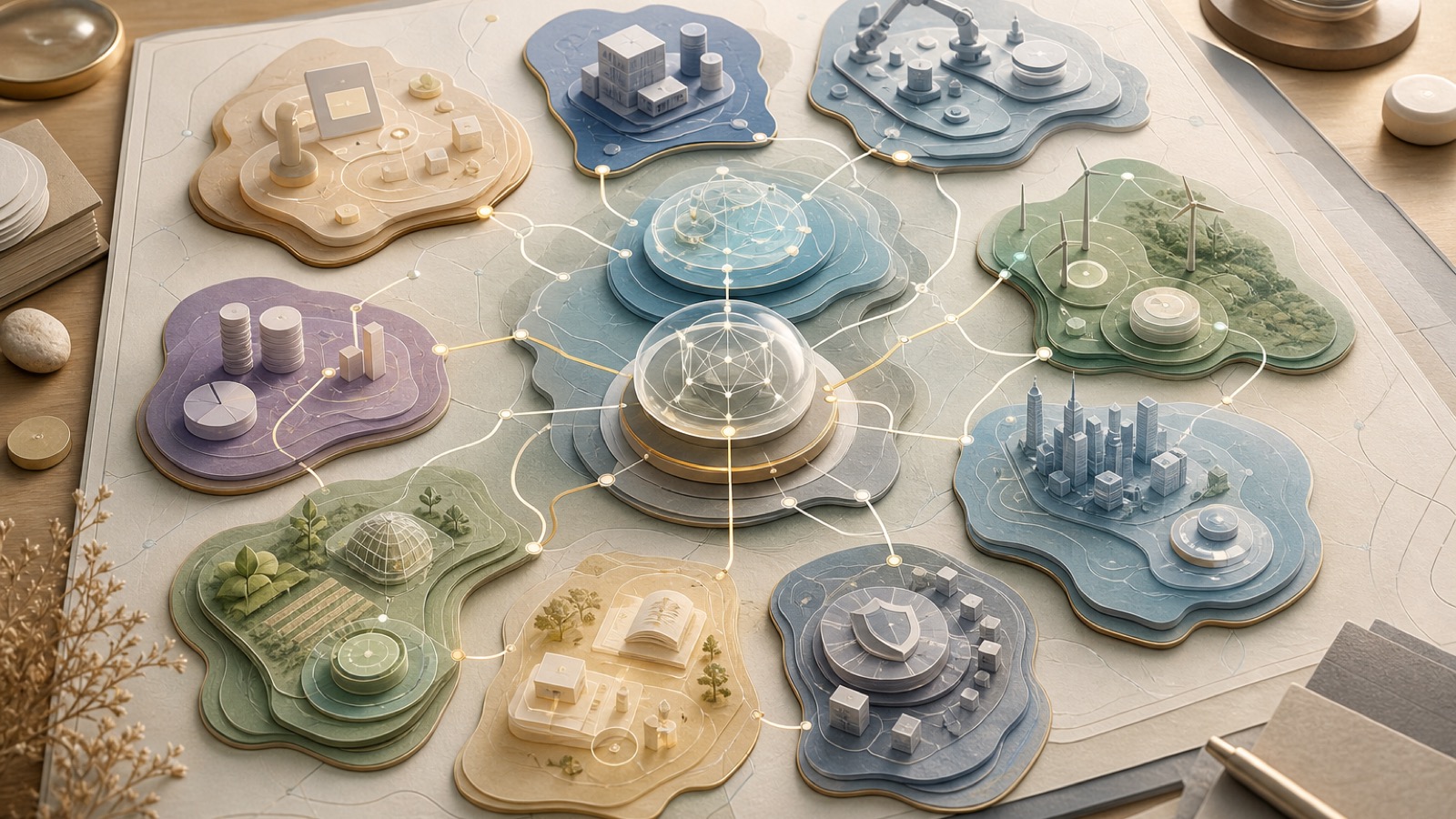
1. Technology Becomes Real Through Products
Every major technology revolution eventually becomes a product revolution. Steam power mattered after it became factories, railways, ships, mines, and industrial cities. Electricity mattered after it became grids, lighting, elevators, motors, appliances, factories, and communications networks. The internet mattered after it became browsers, search, marketplaces, social networks, cloud software, payments, and mobile apps.
AI will follow the same pattern. Models are the seed, but abundance does not come from a model checkpoint alone. It comes from products that turn intelligence into memory, action, coordination, production, discovery, education, healthcare, energy, logistics, and public service.
The important question is no longer only which model is strongest. It is which products can absorb intelligence and turn it into reliable new capability. Some products will be short-lived tools. Others will become infrastructure. The difference matters.
The AI age of abundance will be built by products that convert cheap intelligence into dependable action.
2. Six Layers: From Tools to Infrastructure
The first layer is AI tools: writers, image generators, coding helpers, search assistants, note tools, and chat interfaces. They are useful because they attach AI to a narrow task.
The second layer is copilots. They sit beside an existing workflow and help humans move faster. The third layer is agents. They can pursue goals, call tools, keep state, and execute across steps. The fourth layer is workflow systems, where many agents and humans coordinate around a process.
The fifth layer is operating systems: personal agent OS, enterprise agent OS, robot OS, manufacturing OS, education OS, energy OS. The sixth layer is infrastructure: compute, energy, trust, data rights, identity, audit, safety, logistics, and manufacturing capacity. The higher a product moves in this stack, the more durable it can become.
3. Personal Agents: A Second Brain That Can Act
A personal agent is not just a chatbot with a better memory. It is a long-running context and action system. It understands your work, calendar, files, notes, preferences, goals, health signals, relationships, decisions, and recurring tasks.
The value is not that it answers one question. The value is that it can maintain context over time, connect information across apps, notice what changed, and help you move toward goals. It can prepare a meeting, draft follow-ups, organize research, summarize a week, detect neglected commitments, or turn scattered notes into a plan.
The hard problems are trust, privacy, memory, control, commercial bias, and dependence. A useful personal agent must be easy to correct, easy to inspect, and careful with authority. The product opportunity is enormous, but the governance surface is just as large.
4. Enterprise Agent OS: The New Nervous System of the Company
Most companies are still organized around fragmented systems: CRM, email, docs, tickets, spreadsheets, finance tools, HR tools, code repositories, support systems, and meetings. AI will not transform the company by adding one more chat window. It will transform the company when it becomes an execution layer across those systems.
An enterprise agent OS can coordinate sales agents, support agents, finance agents, legal agents, HR agents, product agents, engineering agents, and management agents. The job is not only automation. It is permissioning, orchestration, audit logs, exception handling, evaluation, human review, and compliance.
This is where enterprise software changes from a system of record to a system of action. The company becomes more measurable, more searchable, and more responsive. But it also needs new operating rules, because AI employees must be managed with the same seriousness as human workflows.
5. AI-Native Companies: Human-Machine Organizations
An AI-native company is not simply a normal company with AI subscriptions. It is designed from the beginning as a system of humans, agents, automation, data flows, and decision loops.
Workflows become more structured. Knowledge is captured automatically. Agents take on repeatable execution. Humans move upward into judgment, taste, trust, relationships, accountability, and system design. The organization can be smaller, but its surface area can be much larger.
The goal is not a company with no people. The goal is a company where responsibility is explicit. AI can execute, but humans still define what matters, decide when tradeoffs are acceptable, and own the consequences.
6. Robots: Intelligence Enters the Physical World
Robots are the dividing line between an information revolution and a material revolution. Without robots, AI mainly changes writing, analysis, software, research, and digital services. With robots, AI can enter warehouses, hospitals, restaurants, hotels, farms, factories, construction sites, eldercare, retail, and homes.
A robot is not one product. It is an ecosystem: hardware, sensors, control models, batteries, safety standards, skills, simulation, fleet management, maintenance, insurance, and real-world data. The opportunity is not only in complete robots, but also in robot operating systems, skill markets, training data, simulation platforms, repair networks, and liability infrastructure.
True material abundance has to wait for intelligent systems to leave the screen. Robots make that possible, but they move at the speed of safety, hardware cost, operations, and trust.
7. AI Factories and Manufacturing Cloud
Manufacturing is the skeleton of abundance. If production remains slow, expensive, and rigid, AI can make us better at imagining products without making the physical world much richer.
An AI factory is the next stage after automation. It senses demand, schedules production dynamically, inspects quality, predicts equipment failure, optimizes energy, reduces waste, manages inventory, and feeds design feedback back into engineering.
Manufacturing cloud goes further. It turns design, simulation, materials, sourcing, prototyping, production, quality control, and logistics into callable platform capacity. A hardware founder could move from idea to design, BOM, simulation, quote, prototype, and fulfillment with far less friction. This is a slow path, but if it works, it changes who can build physical products.
8. Energy, Logistics, Agriculture, Education, Finance
The product map widens once AI enters infrastructure. Energy systems decide the ceiling for compute, robots, factories, vertical farms, desalination, and smart cities. AI can forecast load, route storage, optimize industrial energy use, and coordinate data centers with grids. But AI also creates new electricity demand.
Supply chain and logistics decide whether material abundance reaches people. AI can forecast demand, optimize inventory, route transport, monitor cold chains, schedule warehouses, and reduce waste. Agriculture and food systems set the floor: sensing, irrigation, crop health, breeding, robotics, vertical farms, and supply-chain tracking all become part of the abundance stack.
Education, healthcare, and finance extend the map into human capability and resource allocation. Private tutors, clinical triage, long-term health memory, research assistants, credit scoring, insurance, compliance, and wealth management all become more capable. But these domains require accuracy, oversight, explanation, and public trust.
9. AI Research Platforms: Accelerating Invention Itself
Among all product categories, AI research platforms may be closest to accelerating the future. If AI improves office work, firms become more efficient. If AI accelerates science, new industries become possible sooner.
A research platform can read literature, generate hypotheses, design experiments, run robotic labs, collect sensor data, analyze outcomes, and propose the next round. This matters for drug discovery, materials science, batteries, semiconductors, climate modeling, protein engineering, agriculture, fusion control, and catalysts.
These platforms can create new medicines, cheaper batteries, better crops, new chips, and lower-cost industrial processes. They also create biosecurity, dual-use, monopoly, and transparency risks. The more powerful the invention machine, the stronger the governance must be.
10. Trust and Safety Infrastructure
As AI becomes more common, trust becomes more scarce. People need to know who said something, whether media is synthetic, whether an agent has authority, whether a model is safe, whether a decision is fair, and whether an action can be audited.
This creates a large product category: digital identity, content provenance, watermarking, model evaluation, red teaming, permission management, agent audit, privacy technology, explainability, liability insurance, behavior logs, and compliance systems.
Trust infrastructure will not always look exciting. It will look more like SSL, payments, identity, audit, and security. But without it, abundance becomes information pollution. With it, AI can enter medicine, finance, law, public services, and critical infrastructure.
11. Three Main Lines in the Product Map
The first line runs from personal tools to super individuals. Personal agents, education, writing, coding, health, and finance products give individuals capabilities that once required teams. This supports small teams, solo founders, and people with unusually high leverage.
The second line runs from enterprise software to enterprise intelligence systems. Agent OS, AI collaboration, CRM, finance, legal, HR, product, engineering, and supply-chain systems turn companies from software-recorded organizations into intelligent execution systems.
The third line runs from digital intelligence to physical abundance. Robots, factories, manufacturing cloud, logistics, agriculture, energy, healthcare, cities, and trust systems are the long arc. If only the first line matures, AI mostly improves personal productivity. If the second matures, companies become more productive. Only the third can lower the cost of material life and essential services.
12. The Future Product Is a New Technology Stack
The most important products are likely to be infrastructure products: personal agent OS, enterprise agent OS, robot OS, manufacturing cloud, AI research platforms, AI energy systems, healthcare infrastructure, education infrastructure, civic operating systems, and trust infrastructure.
They share a pattern. They are not one-time features. They live inside long-running workflows. They connect multiple systems. They accumulate data. They create standards. They carry responsibility. They shape ecosystems.
The AI product revolution is not another chat box on the screen. It is a redistribution of human capability: more people with teachers, health guardians, research assistants, company-scale tools, safer robots, cleaner energy, faster science, better public services, and stronger trust. The product map of abundance is a map of which parts of human capability can finally become widely accessible.