
Imagining the AI Age
of Abundance
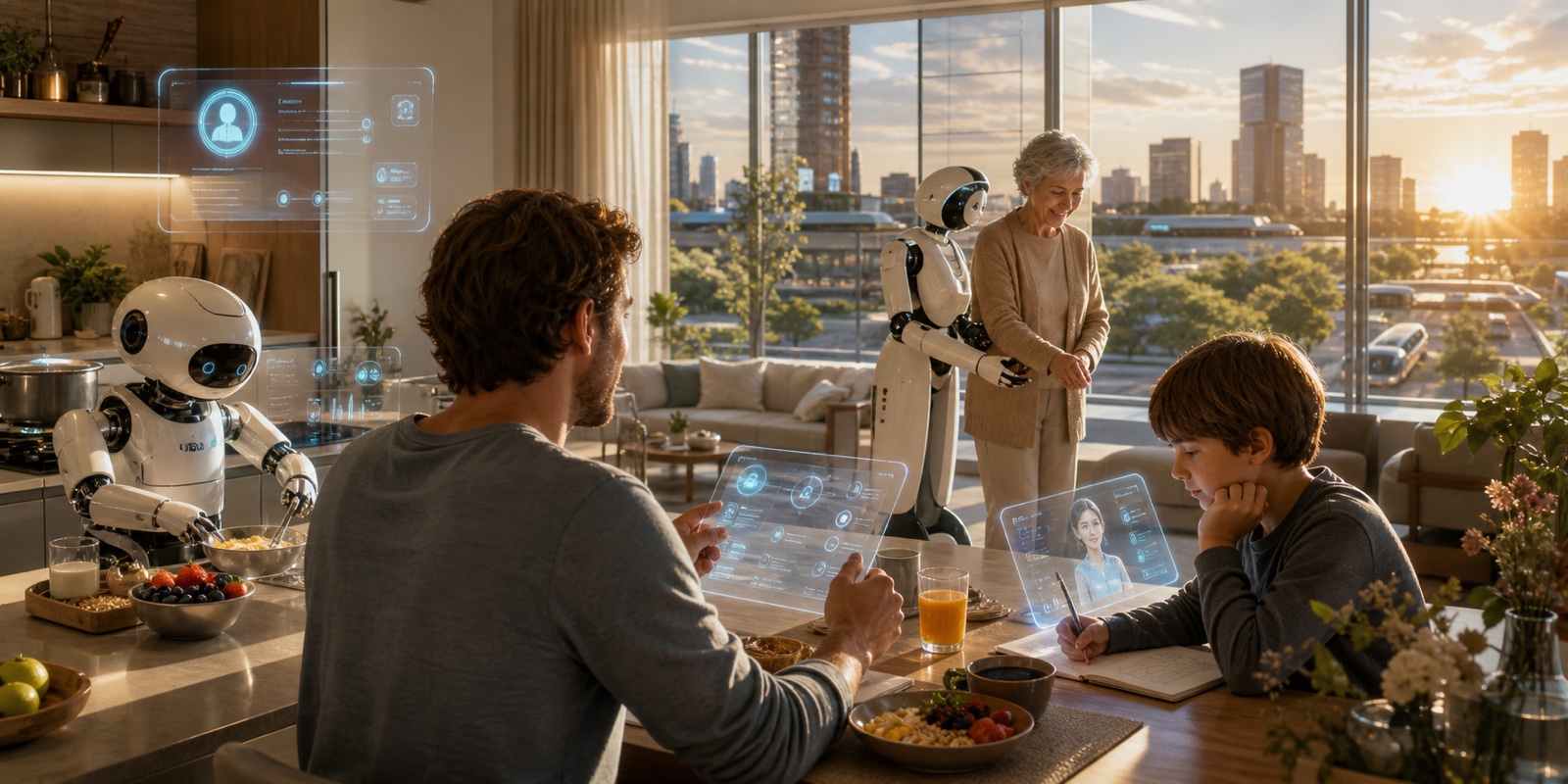
1. A Morning in 2030: the Personal Agent Becomes the Interface of Life
A morning in 2030 does not have to look like a movie. There may be no flying cars outside the window, and not everyone lives under a white city dome. The real change may be quieter, less dramatic, and much closer to the body.
Before you wake up, the health system at home has already been working for hours. It has read your sleep quality, heart-rate variability, glucose movement, breathing rhythm, and yesterday’s exercise. It knows you have an important negotiation in the morning, a school project presentation with your child in the afternoon, and a block of reading time at night. It moves your alarm from 7:00 to 7:18 because you have just entered deep sleep, and waking a little later will leave you clearer.
In the kitchen, a small robot is preparing breakfast. Not simply because it knows what you like, but because it understands your health goals, fridge inventory, family preferences, schedule, and local ingredient supply. Today it skips the high-sugar fruit bowl and makes low-glycemic oats, protein, and a small amount of nuts, because your health agent noticed more nighttime glucose volatility over the past few days.
When you open your eyes, the humidity is adjusted and the curtains are half open. Instead of a flood of notifications, your personal agent gives a rhythm summary: three things truly matter today. The 10 a.m. customer negotiation needs your judgment on the price floor. Your child’s afternoon presentation is a promise you made. You have slept poorly for five days, so work after 9 p.m. is not recommended.
It has already cleared 37 low-priority emails, drafted 8 replies for your approval, cancelled two meetings that can be handled asynchronously, reminded a teammate to add a contract attachment, and synced three action items from yesterday’s meeting into the project system.
This is what a mature personal agent looks like. It is no longer a chat box waiting for prompts. It is an operating layer for life: understanding goals, protecting boundaries, filtering noise, and helping you keep attention for what matters. But the design choice is sharp. Is this agent serving you, or the platform? Does it optimize long-term health, or consumer conversion? Does it reduce noise, or feed more precise content? Does it protect attention, or occupy it? The morning of the future looks gentle, but underneath it is a competition between institutions and product values.
2. The Future Home: Robots Are Not Servants, but New Household Infrastructure
If the personal agent is the software interface of future life, the home robot is its physical interface. A mature home robot will probably not perform like the electronic butlers of early advertising. It will more likely fade into the background, like electricity, water, networks, and appliances.
It will clean floors, but not only sweep. It will organize objects, but not only move them. It will look after elders, but not only monitor them. It will help children learn, but not only answer questions. It may manage the kitchen, medicine cabinet, clothes, air quality, and home safety, but it should not turn the home into a cold automation factory.
A mature home robot has to understand that a home is not a production site. A factory pursues efficiency. A home pursues safety, comfort, intimacy, memory, and boundaries.
In a three-generation household, a robot can remind an elder to take medicine without becoming a supervisor. It can help them stand up and train for recovery while respecting the dignity of not wanting to be treated as a patient. It can practice language with a child without replacing the emotional connection of a parent’s bedtime story.
What matters most is not how much the robot can do, but which things it knows not to do. It needs to know the privacy boundary of a bedroom, that some family conversations should not be recorded, that a child needs to fail and clean up their own toys, that elders need help and dignity, and that family conflict cannot be solved by direct efficiency optimization.
The closer technology gets to the body, emotion, and intimate relationships, the more restraint it needs. Abundance is not machines filling every gap in life. It is releasing people from repetitive burden so that time can return to care, rest, creation, and growth.
3. The Future School: Every Child Has an AI Tutor, but Still Needs Human Teachers
A ten-year-old learning math no longer faces one textbook and one classroom speed. Her AI tutor knows she keeps confusing the whole and the part in fractions, and it knows she likes drawing and dinosaurs. So it explains fractions through dinosaur fossil puzzles and equations through proportions in drawing. It does not give the answer directly. It designs questions that get harder step by step, watches where she gets stuck, and changes its explanation.
Another child who loves history does not only read a chapter about the French Revolution. He enters an AI-generated historical simulation and talks with a baker, an aristocrat, a revolutionary, and a soldier. He learns that history is not a single line of facts, but a collision of interests, ideas, technology, food prices, and institutional failure.
Education moves from the same time, same place, same speed, and same material toward personalized paths. But human teachers do not disappear, because education is not only knowledge transfer. Children need to be seen, encouraged, and challenged. They need peers, frustration, empathy, and someone who helps them understand what is worth pursuing.
AI can explain Newton’s laws, but it may not tell a child why honesty matters. It can grade writing, but it may not notice the loneliness hidden inside a sentence. It can generate practice, but it may not give the timely word a good teacher offers when a student is about to give up.
The future school becomes less a knowledge delivery center and more a growth community. AI handles personalized practice, instant feedback, and explanation. Human teachers ignite curiosity, build community, shape character, and notice potential.
This changes the meaning of educational equity. In the past, equity meant every child had textbooks and teachers. In the future, it may mean every child has a high-quality AI tutor and still receives real human care and social growth. If only wealthy families get the best tutors, AI widens the gap. If public education provides strong basic AI, it may become one of the most powerful tools for educational access in history.
4. The Future of Work: Companies Become Smaller, Individuals Become Larger, Organizations Become Networks
A future company may have fewer employees and more capability. Its hierarchy may be flatter, its system more complex, and its boundary more fluid. Internal employees, outside experts, AI agents, robots, manufacturing clouds, and data platforms may complete work together.
A twelve-person team could run a global company. Three people manage product judgment and customer relationships. Two handle core technical architecture. One leads brand and content. One handles finance and compliance. The rest focus on complex business decisions and partnerships. Around them are dozens of AI agents: sales, support, market research, code, finance, legal, supply chain, data analysis, and user feedback.
The weekly meeting stops being a round of status reports. The system already generates the list of anomalies and opportunities: which market is converting unusually well, which customer group may churn, which feature triggered negative feedback, which supplier may delay delivery, which competitor is changing pricing. Humans no longer meet to ask what happened. They meet to decide what it means.
This is the shift in AI-native organizations: information collection and first analysis are automated; human meetings move from synchronization to judgment.
Individuals also become larger. One person can have a virtual team. A freelancer can serve global customers. An artist can finish work once reserved for a studio. A researcher can read across fields. A small business owner can call on finance, legal, support, and supply-chain systems.
But this freedom is uneven. People who know how to use AI are amplified; people who do not are marginalized. People with data, brand, judgment, and networks are amplified; people with only replaceable execution are compressed. The biggest change is not that humans stop working. Work shifts from executing tasks to organizing humans, AI, and resources around goals.
5. The Future City: From Concrete System to Real-Time Living Organism
Cities have always been collections of technologies. Ancient cities depended on walls, wells, roads, markets, and granaries. Industrial cities depended on railways, factories, ports, gas, and sewers. Modern cities depend on grids, subways, cars, communications, hospitals, schools, and finance. Future cities will depend on data, sensors, AI, smart grids, autonomous mobility, robots, and digital twins.
A mature AI city is not a place covered in screens and robots. It is a city that can sense and regulate itself in real time, almost like a living organism.
Before a storm arrives, the city’s digital twin predicts which roads may flood by reading weather, drainage, water levels, terrain, and traffic. Drainage is scheduled early, traffic is rerouted, community agents notify residents, and emergency resources are staged before the crisis becomes visible.
At peak electricity demand, the system coordinates data centers, storage, EV charging, commercial cooling, and household use to reduce pressure. Residents do not need to understand the dispatch logic; they see more stable prices, fewer outages, and cleaner energy. Transport systems adjust autonomous buses, shared cars, walking networks, bike lanes, lights, and night logistics around real demand and safety.
Public service becomes more proactive. Rising fall risk among elders can trigger visits. A neighborhood with rising unemployment and mental-health risk can receive training and counseling resources. Schools can see widening learning gaps and adjust support. Planners can simulate the long-term impact of transit, housing, and hospital decisions.
This is a responsive city. But its deepest risk is surveillance. If the city senses everything, who controls the data? If algorithms allocate resources, who decides priority? If public safety predicts risk, how do we avoid discrimination? If behavior is continuously recorded, how much privacy remains? The key is not a smarter city, but a more trustworthy one.
6. The Future of Science: Scientists, AI, and Robotic Labs Discover the Unknown Together
The future lab may work like an organism. AI reads papers and databases. Models propose hypotheses. Robots prepare reagents and run experiments. Sensors record results. AI analyzes data and finds anomalies. Scientists decide which anomalies deserve pursuit. The next round of experiments is designed automatically.
Scientific discovery moves from manual exploration to human-machine search. In drug discovery, AI can screen vast molecular spaces. In materials science, it can predict battery materials and catalysts. In climate science, it can raise model resolution. In biology, it can help understand proteins, gene regulation, and cellular networks. In engineering, it can optimize structure, flow, heat, and manufacturing.
The scientist’s role changes. Less time goes to retrieval, calculation, trial, and record-keeping. More value sits in asking questions, judging anomalies, setting direction, understanding meaning, and building cross-disciplinary connections.
The most important breakthroughs in the history of science often come from curiosity, crossing fields, and sensitivity to anomalies. AI can expand the search space, but humans still have to decide which question is worth asking.
The strongest science teams may not be the largest. They may be the teams best at organizing AI, data, experimental platforms, and human intuition. If AI research platforms mature, the age of abundance accelerates because intelligence is not only applying existing technology. It is accelerating invention itself.
7. The Future of Entertainment: Everyone Has a Generative Universe
Future entertainment may become extraordinarily rich. Films may no longer be fixed works; they may generate different versions for different viewers. Games may move beyond preset maps into worlds, characters, and plots generated in real time. Music may be composed around mood, memory, and environment. Virtual characters may accompany people for years and remember every conversation.
A child can create an animated universe. An elder can revisit the street where they lived when young. An ordinary person can generate a short film. A small team can prototype a large game. An independent musician can work with a virtual band.
This could become a new renaissance. But it could also become meaning inflation. When stories are infinite, which stories are remembered? When characters are infinite, which characters are loved? When music is infinite, which melody stays with a life? When virtual relationships are infinite, how do real relationships remain strong?
Entertainment may split. One layer is low-cost, highly personalized, instant AI content. Another layer becomes more precious: human creation, live experience, community culture, and shared memory.
AI can generate entertainment, but culture needs community. AI can generate characters, but relationships need responsibility. AI can generate stories, but meaning needs humans to believe together. The key design question is not how to keep people immersed longer. It is how immersion helps them return to real life richer.
8. The Future of Finance: Everyone Has a Financial Agent, but Capital Still Needs Ethics
Everyone may have a financial agent. It knows income, spending, debt, family goals, risk preference, insurance gaps, retirement plans, and taxes. It helps manage budgets, flags unnecessary spending, compares loans and insurance, automates long-term allocation, and gives risk warnings when major decisions appear.
This could bring ordinary people services once limited to private banking. Small businesses may have financial agents that forecast cash flow, warn about receivables risk, optimize inventory, prepare tax files, and compare financing options. Financial institutions may become more intelligent at fraud detection, credit evaluation, claims, markets, and compliance.
But finance is not calculation. It is trust and responsibility. If a financial agent is driven by platform incentives, it may recommend what is best for the platform, not the user. If AI credit models contain bias, they may systematically exclude certain groups. If many trading models follow similar signals, they may amplify volatility. If individuals over-rely on AI, they may lose basic financial judgment.
Financial abundance is not only more advice. It is more transparent, fair, explainable service that supports long-term life goals. Capital needs efficiency, but also ethics. AI can move capital faster, but humans must decide where capital should flow: short-term speculation or long-term innovation, attention platforms or health and education, high-energy entertainment or climate adaptation and infrastructure.
9. The Future of Space: When AI Carries Human Vision Beyond Earth
The farthest imagination of an age of abundance may not be on Earth’s surface, but in space. AI can make exploration more autonomous, cheaper, and more frequent. Satellites can process data in orbit instead of sending everything back. Lunar robots can build infrastructure. Mars probes can adjust their path in real time. Asteroid mining systems can identify resources. Space manufacturing can use microgravity to produce special materials. Space-based solar power may become a long-term energy option.
Space exploration once depended on national engineering and a small number of astronauts. It may become a long civilizational project driven by AI, robotics, commercial space, and international research networks.
The meaning of space is not only resources. It lets humans see Earth again. From space, borders disappear. Climate systems, oceans, forests, and city lights become one whole. That view may change political imagination: humanity is not merely a collection of separate nations, but one species living on the same fragile planet.
But space can also reproduce Earth’s problems: resource competition, orbital congestion, debris, militarization, monopoly, data control, and colonial ethics. AI and space need governance earlier than the internet had it. Otherwise we carry Earth’s competition and inequality into the universe. The ideal of space abundance is not escape from Earth. It is using the cosmic view to care for Earth better.
10. The Future of Spiritual Life: After Abundance, Humans Still Search for Meaning
If one day food, education, basic healthcare, transport, content, and many services become cheaper, will humans stop being anxious? Not necessarily. Anxiety changes shape. In earlier ages people worried about survival. Later they worried about success. In the future they may worry about meaning.
When AI can complete many tasks, people ask what remains irreplaceable. When robots take on much labor, people ask why they should still strive. When content is infinite, people ask what they truly like. When virtual companionship feels perfect, people ask why real relationships still matter. When life is extended by medicine, people ask what longevity is for.
Abundance does not automatically solve existential questions. The more abundant a society becomes, the more directly people face themselves. In scarce societies, many people have no time to think about meaning because survival consumes everything. In abundant societies, the question rises to the surface.
This may bring cultural renewal or spiritual emptiness. Future society may need to value philosophy, art, religion, psychology, community, nature, ritual, intergenerational relationships, public discussion, volunteering, and bodily work again. These things may look low-tech, yet become more important in the AI age.
AI can generate answers, but it cannot live a life for someone. It can simulate companionship, but it cannot take responsibility inside a real relationship. It can generate art, but it cannot replace the pain and joy of creating. The best abundance society is not one where people do nothing. It is one where more people can choose things worth doing.
11. Design Principles for the Age of Abundance
If we want the future to move in a better direction, we need design principles.
Augment people, do not replace them. AI should help people become more capable, not more passive. Good AI products make people better at learning, judging, creating, and caring for themselves and others.
Reduce friction, do not occupy attention. The best future technology does not addict users. It helps them finish what is necessary faster and return time to real life.
Serve long-term goals, not short-term stimulation. AI should not only optimize clicks, purchases, and time spent. It should help with health, learning, relationships, creation, and other long-term goals.
Keep humans in key decisions. In high-risk fields such as medicine, law, finance, education, public services, and city governance, AI can assist, but humans must keep responsibility and appeal mechanisms.
Let public services benefit early. AI abundance is not enough if it only happens in commercial consumption. Education, healthcare, elder care, disability support, climate adaptation, and government services should be priority scenes.
Protect real relationships. AI can accompany people, but it should not degrade human relationships. Product design should help people return to family, community, and real interaction.
Allow low-tech life. Abundance should respect people who do not want to be surrounded by algorithms. Part of future freedom is the right to turn systems off, avoid tracking, and keep low-tech spaces.
Make systems explainable, exit-able, and portable. Personal agents, health data, learning records, and enterprise workflows should not trap users. A system that truly serves people lets them leave with their data and memory.
12. The Biggest Question for the Future: What Do We Want to Use Intelligence For?
The AI age of abundance is ultimately not a capability question. It is a direction question.
We can use AI to make more advertising, or to treat disease. We can use it to generate infinite entertainment, or to educate children. We can use it to optimize financial speculation, or to accelerate clean energy. We can use it to monitor workers, or to reduce meaningless labor. We can use it to manipulate attention, or to protect attention. We can use it to replace people, or to augment them.
AI itself will not decide the shape of abundance. Human goals, product design, institutions, and distribution of gains will decide the future.
Technology provides possibility. Products organize possibility. Institutions filter possibility. Culture gives possibility meaning. The AI age of abundance is the same.
13. Final Chapter: Abundance Is Not the End, but a New Beginning
If humanity really moves toward an AI age of abundance, it will not be the end of history. It will open new questions.
When basic life becomes easier to secure, how do humans define success? When work no longer occupies all of life, how do humans use time? When education becomes highly personalized, how do humans keep a shared culture? When medicine extends life, how do humans face death? When robots take on labor, how do humans understand the body? When AI generates art, how do humans understand creation? When virtual worlds become extremely rich, how do humans choose reality? When space becomes a new frontier, how do humans avoid repeating old logics of conquest?
Abundance is not the absence of problems. It is the chance to face higher-level problems. The question of a poor age is how to survive. The question of an industrial age is how to produce more. The question of an information age is how to connect more. The question of an AI age of abundance may be: how do we become more fully human?
The AI age of abundance should not mean machines doing everything for people. That world may look easy, but it would be hollow. The future worth pursuing is one where human capability is amplified, basic scarcity is eased, public services become more accessible, creation has a lower threshold, time is freer, relationships are more real, and meaning is richer.
Such a future will not appear automatically. It needs engineers to design tools, entrepreneurs to create products, scientists to explore the unknown, teachers to cultivate judgment, doctors to protect life, policymakers to build institutions, artists to keep imagination alive, and ordinary people to keep learning, choosing, and participating.
If AI is a new fire, the age of abundance is the question of what kind of home humanity builds around it. Fire can illuminate, and it can burn. AI can release people, and it can trap them. In the end, the future is not in the hands of machines. It is in how we use machines together. The true task is not to fill the world with more intelligence, but to make intelligence help humanity create a world more worth living in.