
Seven Ways AI Abundance
Can Fail
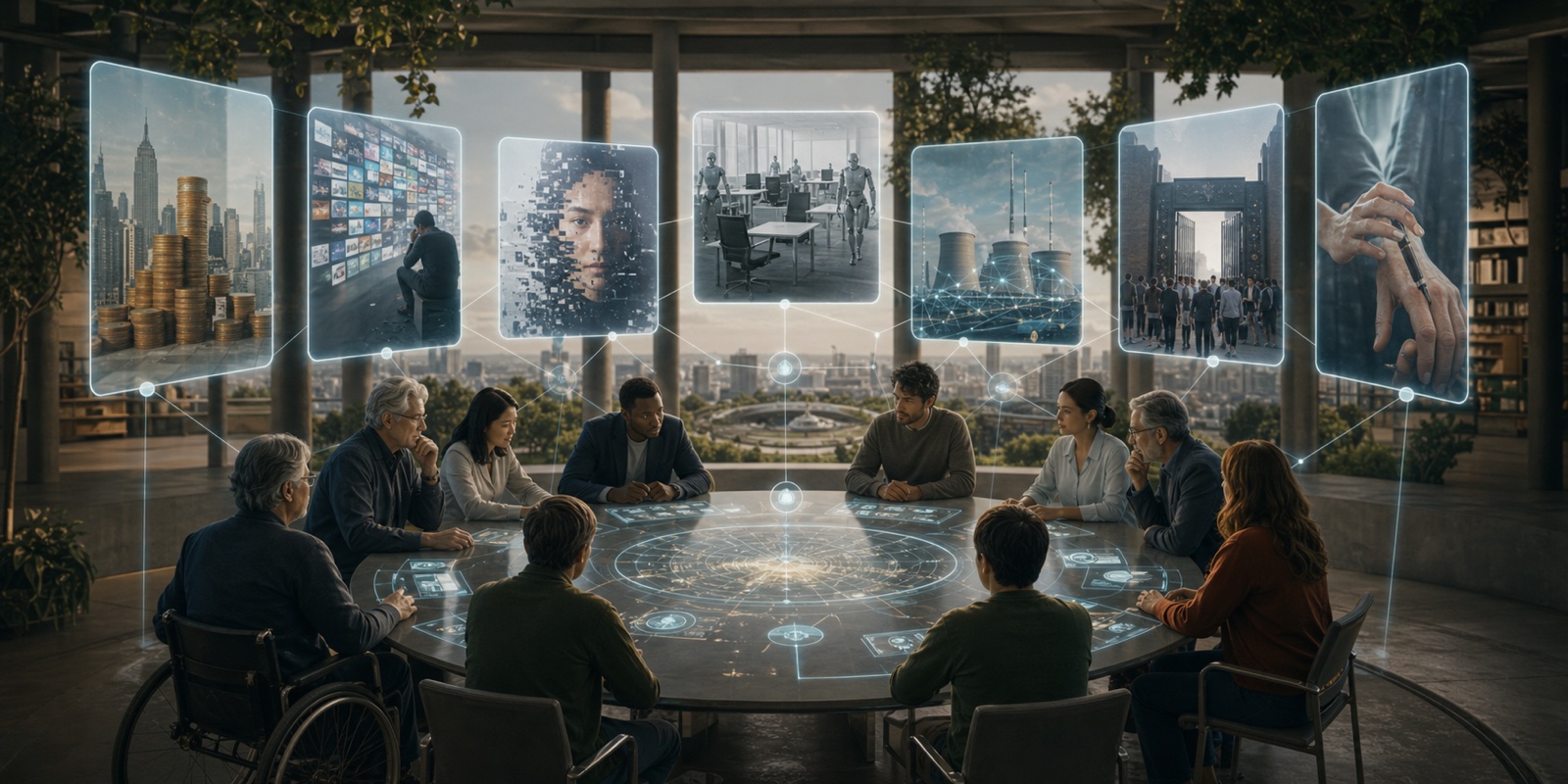
1. Every Abundance Has a Shadow
Every technology revolution has a bright face and a shadow face. Agriculture stabilized food, but also enabled hierarchy, taxation, war, and disease spread. Steam power replaced muscle, but brought coal smoke, child labor, urban poverty, and labor conflict. Electricity lit cities, but also made modern warfare, industrial slaughter, and mass surveillance easier to organize.
AI will be no different. The serious question is not only what new capabilities AI gives us. It is who controls those capabilities, how they spread, under what institutions they operate, who carries the risk, who captures the gain, who can correct the system, and who can shut it down.
The largest risk of the AI age is therefore not simply that AI becomes too smart. It is that human institutions, culture, education, and judgment may not be strong enough to manage a fast-growing general-purpose intelligence.
2. Technical Abundance, Distribution Poverty
The first failure is the most likely and the easiest to miss: technology becomes abundant, but distribution remains poor. Productivity rises. Companies become more efficient. GDP may grow. Goods and services may become easier to produce. Yet ordinary people may not feel the gains if wages stagnate, housing stays expensive, healthcare and education remain unequal, and social mobility keeps falling.
In this future, the AI dividend flows mainly to a narrow set of owners: cloud platforms with compute, AI companies with foundation models, chip and data-center capital, user-entrance platforms, large firms with proprietary data, robotics-heavy manufacturers, and actors that control energy infrastructure.
People use AI, but do not own AI. People contribute data, but do not share in the data return. Small companies depend on platform-provided intelligence without much bargaining power. The paradox is sharp: intelligence becomes cheaper, while power becomes more concentrated.
3. Content Abundance, Meaning Poverty
The first visible abundance AI creates is content abundance. Essays, images, videos, music, games, virtual characters, short dramas, ads, comments, summaries, and social updates can be generated at very low marginal cost. Personalization becomes sharper. Entertainment becomes more responsive to immediate desire.
But more content does not guarantee more meaning. A person can wake up to AI-curated news, commute with a generated podcast, take breaks inside endless synthetic video, spend the evening with a virtual companion, and sleep after an AI-generated game adapts to their mood. Everything is smooth. That is the danger.
Human attention is finite. When content is infinite, the fight for attention becomes more aggressive. Public culture and shared facts can weaken. Real relationships may feel less convenient than synthetic companionship. The risk is not that digital life exists. The risk is that virtual abundance becomes a substitute for meaning in the real world.
4. Intelligence Abundance, Trust Poverty
AI expands generation. It also expands forgery. Images, video, voices, identities, chat logs, contracts, news, research papers, reviews, and social relationships can all be fabricated more cheaply and more convincingly.
When generation becomes powerful enough, society faces a basic question: how do we know what is real? Trust used to rest on familiar relationships, institutional certification, legal accountability, media brands, expert reputation, physical evidence, and time. The internet already weakened many of those mechanisms. AI will pressure them further.
Deepfakes can affect elections. Synthetic agents can manipulate opinion. Fake customer support can defraud users. False evidence can complicate legal systems. AI-generated academic debris can pollute knowledge. Without trust, intelligence does not create order; it creates noise with higher production quality.
5. Efficiency Abundance, Employment Poverty
AI will raise efficiency. That does not mean employment improves automatically. Companies can reduce demand for support, operations, copywriting, analysis, junior coding, legal drafting, finance review, and administrative coordination. As robots mature, manufacturing, logistics, warehousing, delivery, cleaning, food service, and care work may also face pressure.
The most dangerous scenario is not everyone losing work at once. It is structural shock: some roles shrink quickly, some regions adapt slowly, some age groups struggle to retrain, some education backgrounds lack transition paths, and new jobs do not appear in the same places for the same people.
History suggests technology can create new work over time, but the transition can be painful. The industrial age required labor law, unions, public education, and social insurance to turn machine productivity into a livable social order. AI may move faster than the institutions built to absorb it.
6. Compute Abundance, Energy Poverty
AI looks digital, but it rests on a physical system: chips, servers, data centers, electricity, cooling, land, water, and transmission networks. As model scale, user demand, and inference volume grow, AI collides directly with energy infrastructure.
The failure mode is easy to imagine. Large companies build more data centers. Grid connections lag. Local electricity prices rise. Water and land become contested. Carbon-heavy generation returns at the margin. The public carries energy and environmental costs while private actors capture most of the AI surplus.
This is dangerous because it weakens the moral foundation of AI abundance. If AI is used mostly to generate more advertising, entertainment, and consumption loops while communities absorb higher energy costs, social backlash will be rational, not anti-technology.
7. Platform Abundance, Freedom Poverty
AI may create a deeper form of platform power. When a small number of platforms control models, compute, data, identity, payments, cloud services, enterprise workflows, and agent ecosystems, they become more than software companies. They become control points for social infrastructure.
Users get more AI services, but become dependent on fewer systems. Businesses gain efficiency, but may lose control over data, customer relationships, and workflows. Developers get better tools, but platform rules, interface prices, model policies, and distribution channels define the boundaries of innovation.
This resembles the internet platform era, but reaches deeper because AI platforms do not only distribute information. They can execute tasks. Lock-in may come through non-portable memory, closed agent workflows, opaque interfaces, exclusive ecosystems, biased recommendation, and pricing changes that users cannot easily escape.
8. Automation Abundance, Human Atrophy
The most hidden failure is human atrophy. AI and robots can help with writing, thinking, memory, judgment, social interaction, creation, and physical work. In the short term, this feels like comfort and productivity. Over time, excessive outsourcing can weaken the capacities that make people capable.
Navigation made many people worse at remembering routes. Search made it easier not to remember knowledge. Recommendation made active choice less necessary. Short video made long attention harder. AI can extend the pattern: if AI writes, people may practice expression less; if AI thinks through problems, people may train logic less; if AI decides, people may carry responsibility less.
Human capability forms through practice, failure, feedback, and patience. A society that removes every difficulty may also remove the path through which depth is built. The goal is not to reject automation. It is to decide which frictions are waste and which frictions are training.
9. AI Governance Is the Governance of Possibility
AI is not an ordinary tool. It is a technology for expanding possibility. It can expand public services, education, healthcare, research, creativity, and material production. It can also expand manipulation, dependency, inequality, surveillance, and escape from reality.
The AI age will not become good automatically. It may become broad abundance, platform abundance, national abundance, virtual abundance, slow abundance, or unstable abundance. The direction depends not only on model parameters and compute scale, but on whether humans build institutions, cultures, education systems, and judgment strong enough to govern the new capability.
AI gives humanity not one fixed future, but a set of amplified possibilities. The work of governance is to make those possibilities grow toward more freedom, fairness, trust, meaning, and human capability.