
Why We Need to Talk About the AI Age of Abundance
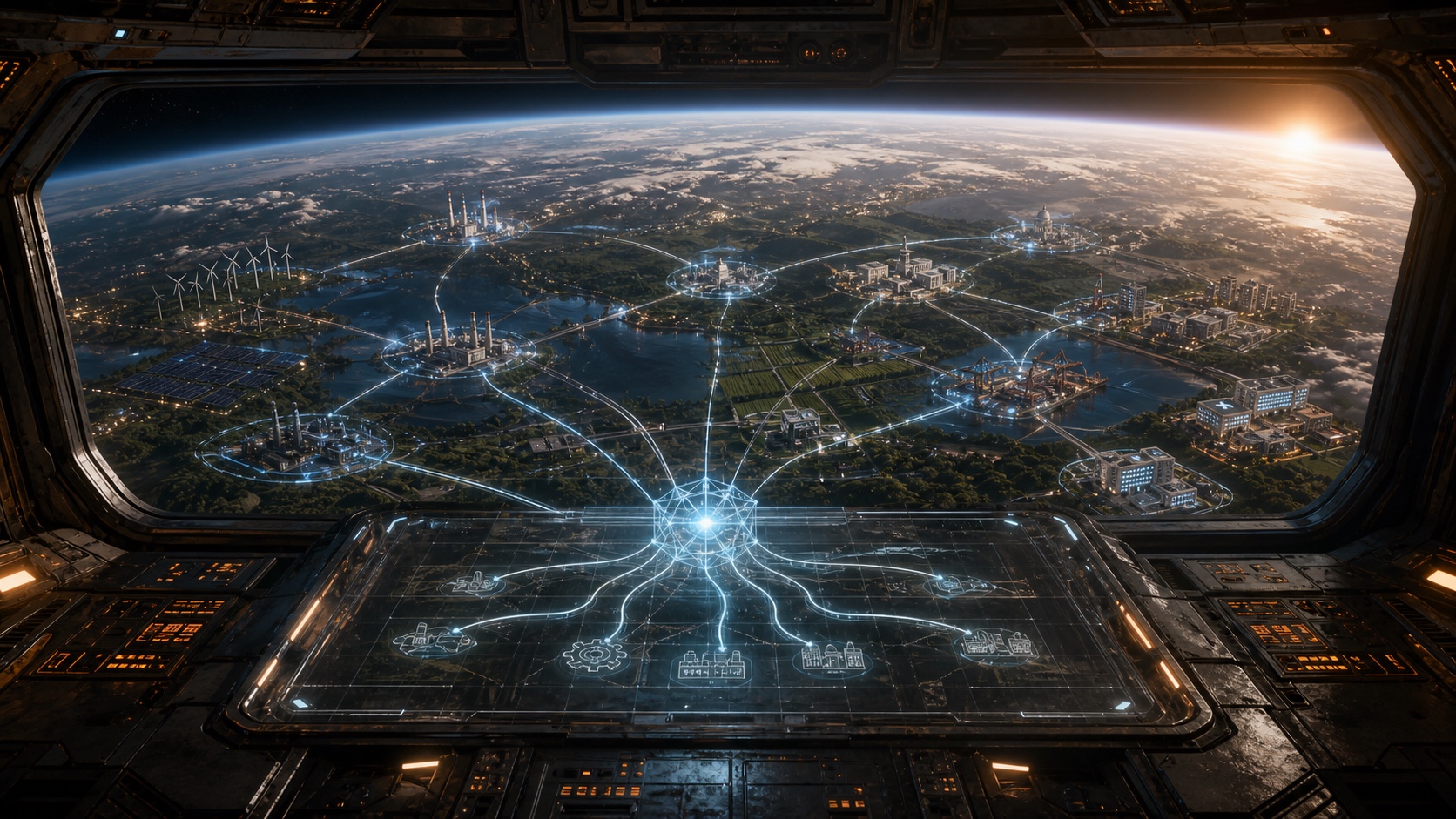
1. A New Historical Question: Can AI Bring Humanity Into an Age of Abundance?
Every so often, humanity encounters a technology profound enough to do more than make one industry more efficient or create a handful of new products. It changes our basic imagination of the world.
Fire changed food and night.
Agriculture changed settlement and civilization.
The steam engine changed muscle and machines.
Electricity changed cities and time.
The automobile changed distance and space.
The internet changed information and connection.
And AI is now changing intelligence itself.
That is exactly why we need to discuss the “AI age of abundance” today.
By “AI age of abundance,” I do not mean that everyone will own more electronic devices, or that content, images, videos, and code can be generated without limit. The deeper question is this: after the cost of intelligence falls sharply, can that change continue to move through energy, manufacturing, healthcare, education, agriculture, logistics, housing, scientific research, public services, and public governance, and ultimately allow humanity to overcome many forms of basic scarcity?
This is also the core vision behind the abundant age described by Elon Musk and other technology entrepreneurs: if AI becomes powerful enough, robots cheap enough, energy abundant enough, and manufacturing and services highly automated, human society may enter an era of dramatically richer goods and services. This vision is not baseless. McKinsey has estimated that generative AI could add $2.6 trillion to $4.4 trillion in annual value to the global economy across just the 63 use cases it analyzed; Stanford’s 2025 AI Index also shows that global private investment in generative AI reached $33.9 billion in 2024, while enterprise AI adoption rose from 55% the previous year to 78%. These figures show that AI is no longer merely a laboratory technology. It is entering the real economy as a general-purpose productive force.
But any discussion of abundance cannot remain an optimistic narrative alone. Technology has never automatically carried humanity into a better world. The steam engine brought industrial production, but also coal smoke, child labor, and slums; electricity brought modern cities, but also intensified capital concentration; the internet brought information freedom, but also platform monopolies, privacy leaks, and information pollution. AI is no different. It may become a tool that moves humanity toward extreme abundance, but it may also become a new system of control, monopoly, and amplified inequality.
So the core question is not simply:
Will AI become very powerful?
Instead, we need to ask:
Can the power of AI be converted into real-world abundance?
Where will that abundance appear first?
Will it benefit everyone, or only a few companies, a few countries, and a few classes?
2. Why “Abundance” Is the Most Important Framework for the AI Era
Over the past few years, most discussions about AI have centered on model capability, AGI, job displacement, business applications, compute competition, regulation, and safety. All of these matter, but they are not the ultimate question.
The truly large question is:
How will AI ultimately change the structure of human scarcity?
By scarcity structure, I mean the things in a society that are hardest to obtain, most expensive, and most limiting to human development.
In agricultural society, the greatest scarcity was food.
In industrial society, the greatest scarcities were energy, machines, and scaled production capacity.
In information society, the greatest scarcities were information gateways, connectivity, and attention.
In the AI era, the first scarcity to be transformed is intelligence.
In the past, if an ordinary person wanted high-quality legal advice, medical guidance, investment analysis, product planning, coding ability, design ability, language translation, or research capability, they usually had to pay a high cost. They either had to hire experts, enter institutions, receive years of education, or rely on large companies and professional organizations. The arrival of AI means these capabilities are beginning to be copied and distributed in a software-like way.
This means the deepest change of the AI era is not that “we now have a chatbot.” It is this:
Expert capability is beginning to detach from the expert as a person and be replicated at scale as products and services.
This is the starting point of intelligence abundance.
But intelligence abundance is not the same thing as social abundance. A person can use AI to generate a perfect business plan, but may still be unable to build a factory; ask AI to explain a medical report, but still be unable to access high-quality healthcare; ask AI to design a house, but still be unable to afford land and materials; ask AI to write automation code, but still lack the electricity, robots, and supply chains needed for real production.
Therefore, the study of the AI age of abundance must shift from “is intelligence strong enough?” to “how is intelligence converted?”
The core conversion chain is:
Intelligence → tools → workflows → organizations → physical production → social distribution.
Only when AI moves from model capability into product tools, from product tools into real workflows, from workflows into restructured organizations, then through robotics, energy, manufacturing, and logistics into the physical world, and finally through institutions and public services into broadly shared outcomes, does the so-called “age of abundance” truly arrive.
3. AI Abundance Is Not “Content Abundance,” but “Capability Abundance”
Many people today have already felt the first layer of abundance brought by AI: content abundance.
Articles can be generated endlessly.
Images can be generated endlessly.
Videos can be generated endlessly.
Code can be completed quickly.
Slides can be produced automatically.
Music, scripts, game assets, and advertising copy can all be created in batches.
But this is only the surface layer of abundance.
If the future only gives us more content, denser short videos, and more realistic virtual characters, while housing, healthcare, education, energy, food, eldercare, and transportation remain expensive, then that is not an age of extreme abundance. It is only an abundance of digital illusions.
What is truly worth discussing is capability abundance.
Capability abundance means that abilities once held only by a small number of people, organizations, or countries gradually become basic resources that ordinary people can call upon.
For example:
Ordinary people can have private tutors.
Small companies can have enterprise-grade researchers.
One person can call on design, development, marketing, customer service, and legal capability.
Rural clinics can obtain diagnostic support close to the level of top-tier hospitals.
Small and midsize manufacturers can use intelligent supply chains and manufacturing clouds.
Developing countries can raise national skill levels through low-cost AI education.
Research teams can use AI to help discover new drugs, new materials, and new energy pathways.
Capability abundance matters more than content abundance because it changes productivity and the structure of opportunity.
Content abundance makes the world noisier and livelier.
Capability abundance may make the world fairer, more efficient, and more creative.
4. Why Now Is the Critical Window for Discussing This Question
We should discuss the AI age of abundance today not because it has already arrived, but because its foundational components are appearing at the same time.
First, large model capabilities are improving rapidly. The 2025 Stanford AI Index shows that commercial AI use is accelerating significantly, global private investment in generative AI continues to grow, and the United States remains ahead in private AI investment. This suggests that AI is moving from experimentation and novelty into industrial diffusion.
Second, robotics is spreading from industrial settings into service settings. Data from the International Federation of Robotics World Robotics 2025 report shows that around 542,000 industrial robots were installed in factories worldwide in 2024, more than double the number from ten years earlier and above 500,000 for the fourth consecutive year; Asia accounted for 74% of new deployments in 2024. The hardware foundation for AI to enter the physical world is becoming stronger.
Third, compute and energy are becoming new bottlenecks. Research on energy and AI from the IEA shows that electricity demand from data centers is growing rapidly, and AI development is now directly tied to power grids, energy storage, and data center construction. AI appears to be software on the surface, but underneath it are chips, data centers, electricity, cooling, and capital expenditure.
Fourth, social institutions are still far from ready. Education systems are still centered on standardized exams; labor markets are still built around jobs and employment relationships; high-responsibility fields such as healthcare and law still depend heavily on professional credentials and regulatory approval; mechanisms for data rights and the distribution of AI dividends are still in early exploration.
This means the next 10 to 30 years will not be a process in which “AI automatically brings abundance.” It will be a process in which human society undergoes a deep institutional reconstruction around AI.
In this window, what matters most is judgment:
Which changes are short-term bubbles?
Which changes are long-term trends?
Which products are merely feature innovations?
Which products will become infrastructure?
Which industries will be restructured first?
Which bottlenecks will delay the age of abundance?
Which social groups will be amplified, and which will be marginalized?
Which countries will enter AI abundance first, and which will be left behind?
5. Basic Position
Neither technological optimism nor technological pessimism.
The core stance is this:
AI is an extraordinarily powerful general-purpose technology, but whether it moves toward broadly shared abundance, platform monopoly, state control, virtual escape, or social imbalance depends on the joint evolution of technology, industry, institutions, and culture.
We should reject two simplistic judgments.
The first is pure optimism: the belief that as long as models keep getting stronger, humanity will naturally enter an age of extreme abundance. This ignores real constraints such as energy, robotics, supply chains, regulation, distribution, and human psychology.
The second is pure pessimism: the belief that AI will only bring unemployment, control, and a crisis of meaning. This ignores the fact that, throughout history, technology has repeatedly expanded human capability, lowered costs, increased longevity, and created new opportunities.
A more accurate judgment is:
AI will amplify the structures society already has.
If a society has open innovation, inclusive education, public services, and fair distribution, AI will amplify those strengths;
if a society has monopoly, information inequality, education gaps, and institutional inertia, AI will amplify those problems too.
Therefore, the AI age of abundance is not a technological outcome. It is a civilizational choice.
6. Five Perspectives
First, the historical perspective.
By looking back at the agricultural revolution, the industrial revolution, the electrical revolution, the automobile age, the information revolution, and the mobile internet age, we can identify the common patterns by which technology moves from invention into products, infrastructure, and institutions.
Second, the productivity perspective.
We can analyze how AI lowers the costs of information, knowledge services, collaboration, research and development, manufacturing, healthcare, education, energy, and housing.
Third, the product perspective.
We can study what new products the future age of abundance will require: personal agents, enterprise Agent OS, AI-native companies, robots, manufacturing clouds, AI research platforms, AI healthcare, AI education, AI energy systems, AI government systems, and more.
Fourth, the institutional perspective.
We can analyze how AI dividends are distributed, and how institutions such as public AI, public compute, data rights, universal basic services, retraining systems, and AI safety regulation shape the final outcome.
Fifth, the humanistic perspective.
When answers, content, services, and productivity all become increasingly abundant, what will remain scarce for human beings? Judgment, meaning, relationships, trust, creativity, spiritual life, and agency.
We should not only discuss “what AI can do.” We should also discuss:
How AI will change the structure of capability, cost, organization, power, and meaning in human society.